Walk Barcelona and clear the grid
The map starts fully hidden and only opens where your feet have been. Barcelona is one of the most satisfying cities on earth for this, because the grid gives you something to finish.
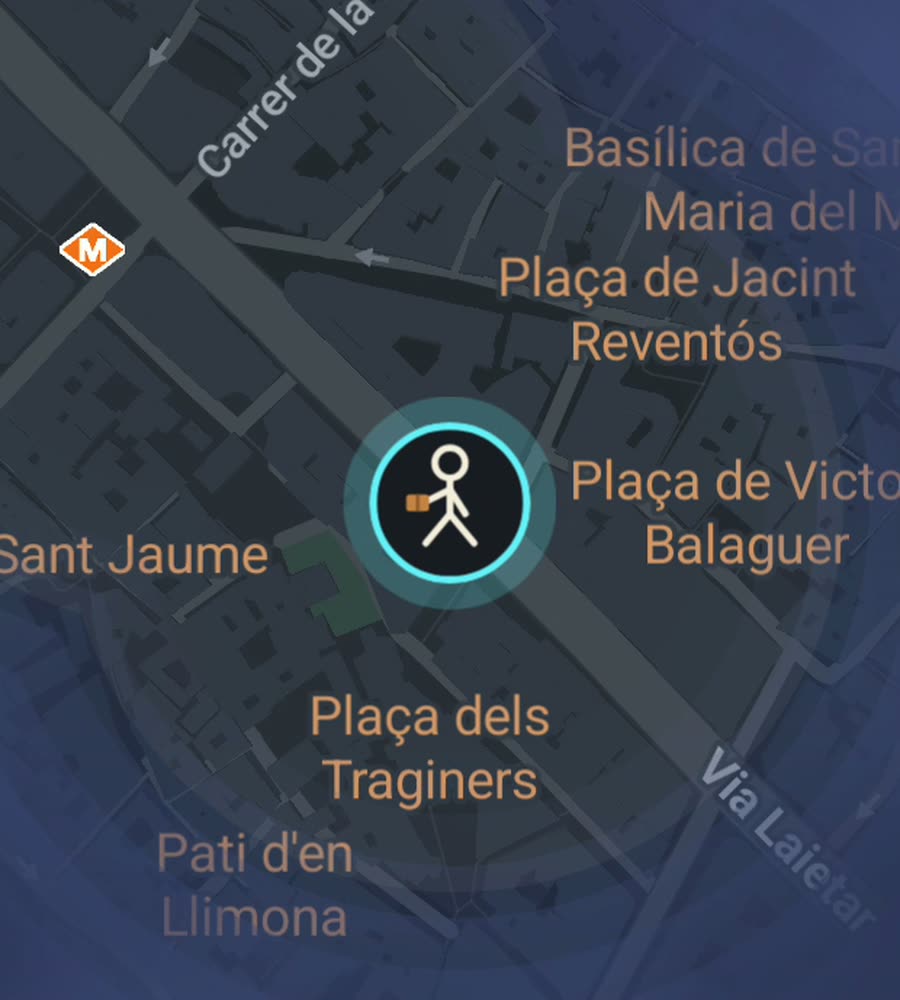
Barcelona on the FOG map, fog burned off along a walked route up through the Eixample into Gracia.
A grid, a knot, and a hill
Barcelona is three walking cities in one. The Eixample is Cerda's nineteenth century grid: square blocks a little over a hundred metres across, each with its corners cut off at forty five degrees so every junction opens into a small octagonal plaza. It is relentlessly regular, and it is the reason this city fills in so neatly. You can walk Carrer del Consell de Cent or Carrer d'Enric Granados in a straight line for a very long time and watch the map open in even steps.
Below it, between Placa de Catalunya and the sea, is the old town: the Gothic Quarter, El Born, El Raval. Narrow stone lanes, sudden squares, streets that change name every eighty metres. It is a knot, and it is where you will spend the most time per hundred metres of cleared map.
Then the ground tilts. Behind the grid the city climbs toward Collserola, and Gracia, Park Guell, the Carmel bunkers and Montjuic all involve real gradient. Nothing brutal, but you will notice the difference between walking north and walking south.
Districts a walker actually crosses
Gracia was a separate town until 1897 and still behaves like one, a pocket of small squares (Placa del Sol, Placa de la Vila de Gracia) and streets too narrow for the grid it is welded onto. Poblenou, east along the coast, is the old industrial quarter reworked into wide blocks with a leafy Rambla of its own. Barceloneta is a tight triangle of long thin blocks between the port and the beach, laid out for fishermen and still feeling like it.
The seafront is the easiest continuous walking in the city: a promenade running from Barceloneta past Port Olimpic to Bogatell and Mar Bella, flat, uninterrupted, and about five kilometres if you take it all. Passeig de Gracia and La Rambla are the two great north south spines, and both are worth walking even when they are full.
An afternoon that gains height
Start at Placa de Catalunya and walk straight up Passeig de Gracia, past the Gaudi facades, to Diagonal. Cross into Gracia and wander deliberately: Carrer Gran de Gracia, then east through the small squares. Keep climbing to Park Guell, come out at the top, and continue up to the Bunkers del Carmel for the view back over everything you just cleared. Drop down the far side into Guinardo.
Call it eight kilometres with about two hundred metres of climb. It cuts a clean line from the flat grid into the hills, and the cleared shape on the map afterwards tells the story of the terrain better than any photo.
How the fog fills here
The Eixample is the best argument for this app anywhere. Because the blocks are identical and the grid is complete, you can work one district methodically and end up with a solid, obviously deliberate rectangle of light. Missing a single street is visible from across the map. It turns walking into a slightly compulsive completion exercise, and the district is small enough that finishing it is realistic.
The old town is the opposite. In the Gothic Quarter the lanes are narrow and the stone is high, so the signal bounces and the trace can drift a metre or two off the alley you are actually in. It sorts itself out on the wider streets. Expect the old town to look messier than it felt.
Barcelona is compact enough that the city percentage moves visibly week to week, which most large cities cannot offer. FOG keeps revealing with the app closed and the screen off, ranks climb with the area you cover, and nothing you walk ever leaves the phone.
Questions people actually ask
Why does the Gothic Quarter look untidy on the map?
Narrow lanes with tall stone on both sides make the signal bounce, so the trace can sit a metre or two off the alley you walked. It resolves on wider streets.
Can I realistically finish a district?
In Barcelona, yes. The Eixample grid and neighbourhoods like Gracia and Barceloneta are small and regular enough that walking every street is a real weekend project.
Does it record while my phone is away?
Yes. Background exploring keeps revealing streets with the app closed and the screen off.
What does it cost?
Free to explore. One purchase of USD 5.99 unlocks unlimited ranks, every character and history import. No subscription, ever.
Can I import a trip I already took?
Yes, with the paid unlock. FOG imports Google Timeline exports and GPX files, so an old week in Barcelona can be added to the map.
Start with a dark map.
FOG is free to explore. No account, no subscription, and your map never leaves your phone.
free to explore · one purchase unlocks everything · never a subscription