Rio de Janeiro, one street at a time
The whole world map starts hidden under fog. In Rio you burn it off along the beachfront, around the Lagoa and up into Santa Teresa, and what you have walked stays lit.
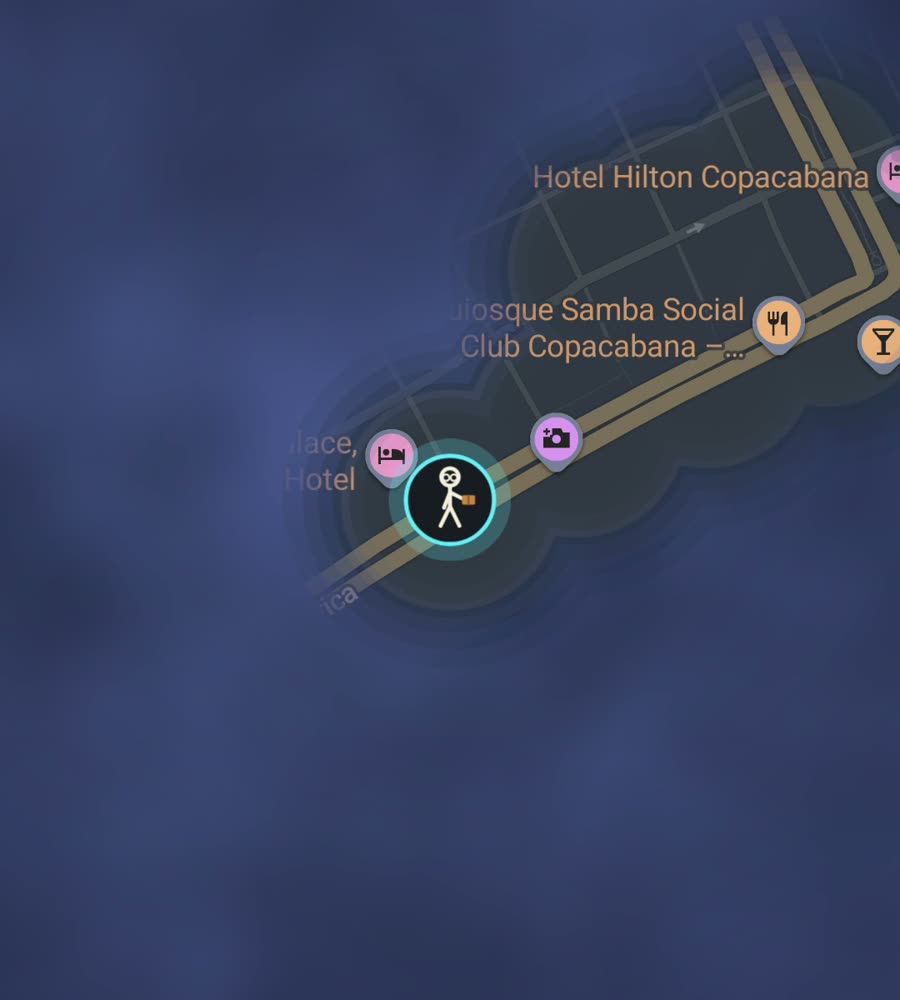
Rio de Janeiro on the FOG map, with the fog burned off along a walked route through the Zona Sul beachfront.
The strip between the rock and the sea
Rio is not laid out so much as squeezed in. Granite mountains come down almost to the water and the city fills whatever is left over. In the Zona Sul that leaves a strip four or five blocks deep between the sand and the rock: Leme, Copacabana, Arpoador, Ipanema, Leblon, one after another. Behind them the ground goes vertical. Walk two blocks inland from Rua Visconde de Piraja and you are already climbing.
Centro is a different city entirely. Narrow colonial lanes around Rua do Ouvidor and Travessa do Comercio run into wide avenues like Avenida Rio Branco, and the whole district empties out after dark. Santa Teresa sits above it on a hill, reached by stairs and by the tram, with cobbled streets that bend back on themselves and rarely go where you expect.
An afternoon from Leme to Leblon
Start at Leme, at the far north end of Copacabana, and walk the whole beachfront on the black and white wave mosaic. Copacabana to Arpoador is about four kilometres of it. Cut around the rock at Arpoador and keep going along Ipanema and Leblon and you have done seven or eight.
Turn inland at Leblon and pick up the path around Lagoa Rodrigo de Freitas, which is another seven and a half kilometres right around the water with Corcovado standing over you the whole way. That is a full afternoon, most of it flat, and on the map it comes out as a long clean ribbon with a loop tied on the end.
Why the Rio map has a hole in the middle
Rio does something to a fog map that most cities do not. The Tijuca massif sits in the middle of the built city, thousands of hectares of forest with no streets in it, and you are not clearing that on a normal afternoon. Corcovado, Pedra da Gavea and the ridge behind Sao Conrado stay dark. So does the water. Your Rio ends up as bright coastal ribbons wrapped around a permanent black core, which is a fair picture of what the city actually is.
The flip side is that the walkable parts fill quickly. Copacabana is roughly ten streets wide and forty long. A week of evenings and it is gone. Botafogo, Flamengo and the Aterro do Flamengo park chain onto it, and suddenly you have lit a continuous line from Leblon to Centro.
Heat, hills and honest notes
Summer, roughly December to March, is hot and humid enough that a midday walk is a poor decision. Mornings before nine and evenings after six are the walking hours. On Sundays the beachfront lane of Avenida Atlantica closes to cars, which makes the easiest long walk in the city. Winter is mild and dry and you can walk all day.
Between the towers on Avenida Atlantica, and in the steep lanes of Santa Teresa, the phone can lose its footing and put you a street over. Walk the same block again on a clearer day and it corrects itself. Everything else is ordinary sense: the Zona Sul beachfront and Centro by day are plain walking, and for the rest, ask someone who lives there before you go wandering.
Questions people actually ask
Does FOG work while my phone is in my pocket at the beach?
Yes. Background exploring keeps revealing streets with the app closed and the screen off, so you can walk Copacabana to Leblon without touching the phone.
Can I import walks I already did in Rio?
Yes, with the paid unlock. FOG imports Google Timeline exports and GPX files, so old trips through the Zona Sul or Centro can be added to the map.
Does FOG have Rio routes or guides built in?
No. There are no curated routes, no guides and no local partnerships. The map is the same everywhere on Earth. Only the streets differ.
What does it cost?
Free to explore. One purchase of USD 5.99 unlocks unlimited ranks, every character and history import. There is no subscription.
Where does my Rio map get stored?
On the phone. No account, no sign-up, no cloud, no app analytics, no ads and no tracking. You can export your own data whenever you want.
Start with a dark map.
FOG is free to explore. No account, no subscription, and your map never leaves your phone.
free to explore · one purchase unlocks everything · never a subscription